
WFR Frequently Asked Questions
Wilderness First Responder Courses at Hoofbeat Ridge
Hello WFR Students!
Wilderness First Responder training is a valuable investment, and it’s important to be prepared heading into your course experience. We’ve compiled a list of common questions below to help you find the information you’re looking for.
If you have a question that’s not listed, please don’t hesitate to contact us.
Quick Links:
-
Host - Devils Lake Climbing Guides (DLCG)
We (Devils Lake Climbing Guides) are your WFR course “hosts.” We take care of everything that happens prior to the WFR course itself. We arrange the venue, advertise and sell the course, register & communicate with students, and coordinate with the instructor(s).
Ask us any questions you have about the WFR course venue, payment and/or logistics. If you’re not sure who to ask, send us a note. We’ll answer your questions or point you to the appropriate person.
Curriculum & Instruction - Wilderness Medical Associates International (WMAI)
Wilderness Medical Associates International facilitates the course itself. WMAI provides the instructor, the online portal (Moodle), and the textbook and study materials.
WMAI is the best point of contact for questions about your certification itself - how renewal / recertification works, recertification extension requests, WMAI course policies, etc.
Instructor - Lochsa Wilderness Training
The day before your course, your instructor arrives, we high five, and now they lead the show.
Once you’re enrolled in Moodle (WMA’s online platform), you can send messages directly to your course instructor. They are the best point of contact for questions about the curriculum, pre-course homework, assessment and/or course learning accommodations.
Venue - Hoofbeat Ridge Equestrian Center
Hoofbeat Ridge is our course venue. They provide a gorgeous campus, complete with on-site classroom, bunkhouses, dining hall, hiking trails, and horses (just for looking at, not for riding). Lodging, meals, and class all take place on this property in rural Mazomanie, WI.
Ask Hoofbeat Ridge staff questions you may have about the bunkhouses, bathrooms, food, dietary needs, HVAC and/or the grounds themselves. Hoofbeat staff are also local experts, so they know best about nearby stores, restaurants, churches and recreational opportunities.
-
We host our Wilderness First Responder courses at Hoofbeat Ridge Equestrian Center. The campus is tucked into rural rolling hills, five short minutes uphill from the village of Mazomanie, WI.
If you are flying in to take our WFR course, the closest and most convenient airport is Madison, WI (MSN), which is about 40 minutes away from Hoofbeat Ridge by car. Milwaukee (MKE) is another reasonable option, about 2 hours away by car.
-
Breakfast is served around 7:00 AM.
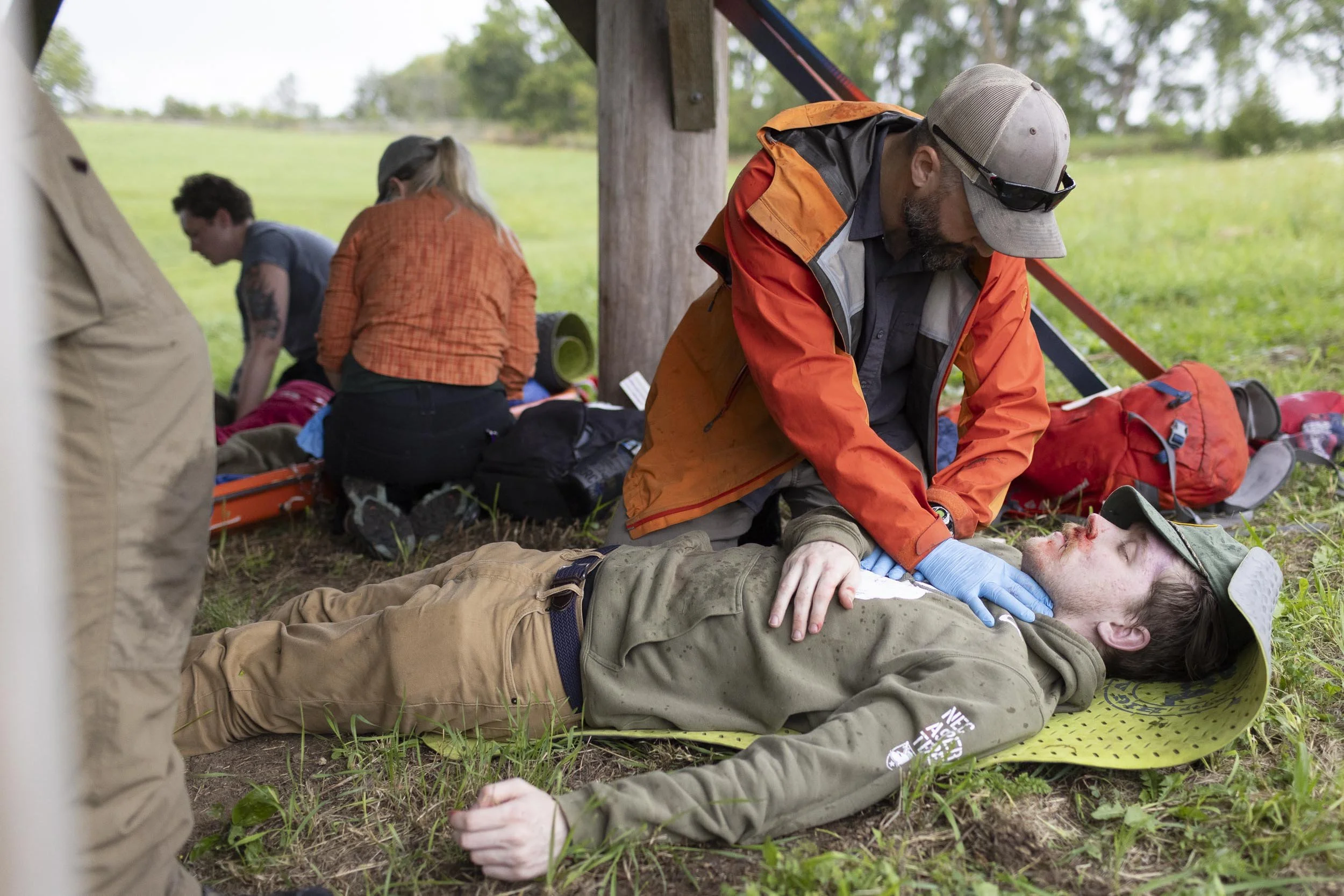
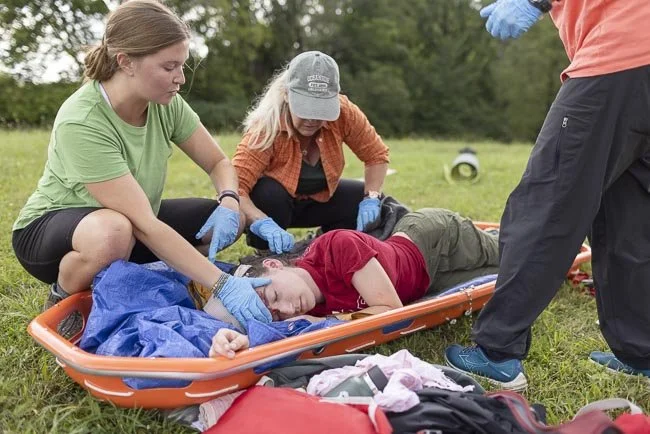
Class begins at 8:00 AM sharp daily. Each day is a mix of classroom lectures, outdoor practice scenarios, and other educational activites.
Lunch is served around 12:00 PM, but may change to accommodate the course schedule.
Class ends somewhere between 5:00 - 6:00 PM, depending on course progress, weather and other variables. Expect homework assignments that need to be completed before the next day’s course. Most courses end by 4:00 PM on the last day.
-
Yes. Students must be 16 years of age to hold a WFR certification. WMAI requires students enrolling in the accelerated 5-Day WFR course to be 18 years or older. Contact WMAI for any questions.
-
Though most larger wilderness medical training schools offer reciprocity, their certification duration varies. Wilderness First Responder certification from WMAI lasts 3 years.
Big Picture Questions
-
Unfortunately, no. There are three main organizations that offer WFR certification: Wilderness Medical Associates (WMA), National Outdoor Leadership School (NOLS), and Stonehearth Open Learning Opportunities (SOLO). WMA facilitates our courses, and neither WMA nor DLCG is able to process Post 9/11 GI Bill funds for you. We don’t have a “VA certifying official”, so we’re ineligible to submit the request, and it looks like the VA doesn’t recognize WMA for these benefits.
NOLS appears to be the only organization that offers wilderness medical training listed as eligible for benefits with the VA. NOLS has more robust infrastructure for folks using VA benefits to cover the cost of their courses.
-
Unfortunately, no, because Wilderness Medical Associates is unable to accept Americorps credits.
According to conservationlegacy.org, you can use your Americorps Education Award for wilderness medicine training through Aerie Backcountry Medicine or NOLS.
-
We don’t offer a “commuter” tuition option.
You don’t have to stay on campus during the course, but Hoofbeat Ridge (our venue) charges us the same amount per person regardless of whether they sleep or eat on campus.
-
Unfortunately, no. These courses are special, limited-enrollment offerings and are non-refundable and non-reschedulable once students have paid their course deposits unless another student is willing to take their spot in class. This includes cancellations due to disrupted travel plans, injury, or illness (including COVID-19). We recommend purchasing trip insurance to protect your tuition investment.
*If we cancel your course due to low enrollment, you may opt to transfer your enrollment to another session or receive a refund of your course fees. Please see our weather and cancellation policies page for full details.
Financial Questions
-
5-Day WFR and 3-Day Recert students all need to complete DLCG’s liability waiver and enroll in Moodle, WMA’s learning platform, as soon as possible. Once enrolled in Moodle, students must complete the intake form, pre-course paperwork, read the textbook, complete a study guide and pass the pre-course exam (due no later than 6:00PM CST the evening before the course begins).
This is an accelerated course, so pre-course study is essential to successfully passing the end of course exam. Attendance alone will not guarantee a passing score.
-
WMA estimates the pre-course work for the 5-Day WFR takes approximately 25 hours to complete. The pre-course work for the Recert students takes approximately 8 hours to complete. This time will vary depending on your learning style, your familiarity with the course content, and other variables.
-
Moodle is the online portal to your course, operated by Wilderness Medical Associates, the course provider. Students use Moodle to complete important pre-course paperwork, access study materials and the pre-course exam, and contact their course instructor.
-
Eight weeks before your course begins, we’ll send you an email with a link to enroll in Moodle and access your course materials. Waiting until the 8-week mark allows WMA to make updates to Moodle, so you can work with the most recent iteration.
-
First, check out WMA’s Moodle How-To or our WFR Guide To Enrollment and make sure you’ve completed each step properly.
If you’re still having trouble, reach out to us. If you’re experiencing a common issue, we can often get students sorted out. If we can’t help, we’ll connect you with the folks at WMA who run Moodle, and they can help.
-
Yes! Please fill out this form to submit your WFR textbook request, and we’ll mail you a hard copy. WFR course enrollment includes a physical textbook; students who do not request their book in advance will receive theirs on Day One of the course.
-
It may vary slightly based on who your instructor is, so we recommend aiming for a score of 85% or above. Please note your instructor can see how long it takes you to complete each attempt and how many times you take it. Since our recertifications and 5-Day courses are accelerated WFR options, your instructor expects you will arrive at the course with a firm understanding of the concepts explained in the textbook, study guide and exam.
Pre-Course Study Questions
Logistics and Venue Questions
-
The following is a general list of what you’ll need:
Clothing layers as appropriate for the weather (bring only clothes that can get dirty)
Sturdy footwear (consider waterproof boots), possibly a few different options
Personal care items (towel, toiletries, etc.)
Notebook and pen (some may prefer a laptop) for taking notes
Camp chair or lawn chair
Sleeping bag and pillow, or other bedding, if you plan to stay in the bunkhouse
Check out our visual WFR packing list for more details.
-
All meals and light snacks are provided from breakfast on the first course day through lunch on the final course day. If you have a hearty or particular appetite, you may consider packing your favorite snacks. Note that supper is not provided during check-in the evening before the course, nor the evening the course concludes.
-
Yes! In fact, we encourage it. Hoofbeat provides great meals, and meals are included in course tuition. Note that supper is not provided the evening before the course begins, nor on the last course day.
-
Hoofbeat can accommodate most, but not all, dietary restrictions. Please indicate your needs upon registration, and Hoofbeat Ridge staff will contact you to discuss further.
-
WiFi at Hoofbeat is generally serviceable for general email needs. However, it is not suitable for streaming video or downloading large files.
Hoofbeat Ridge is located in a rural, hilly setting, and cellular service varies by provider.
-
Car/van camping is available in the parking lot, but tent camping is not permitted. Campers are welcome to use the study area, restrooms, showers, etc. in the bunkhouses.
-
We are unable to transport incoming students to the course venue, but past students have had good luck arranging rides through local taxis or Uber/Lyft. Transport from Madison airport to Hoofbeat Ridge is approximately 45 minutes.
You may be able to get a ride back to Madison from another classmate at the end of the course.
-
See here.
WFR Recertification Questions
-
Wilderness Medical Associates develops and delivers their WFR course curriculums, provides instruction through their contract staff, and sets their certification and re-certification policies. We have no influence or discretion over any of these course elements.
Certifications are valid for three years, and must be re-certified BEFORE they expire. Certifications are never extended beyond their expiration date. There is no grace period.
On a case-by-case basis, WMA may extend a student’s eligibility to re-certify in a recertification course that begins after their certification has expired. Students must inquire about an eligibility extension BEFORE their certification expires.
-
Contact your previous course provider (WMA, NOLS, SOLO). They should be able to track down a record of your certification.
-
Yes. Students must have a current WFR or Outdoor Emergency Care* (OEC) certification (unexpired or within the certifying agency’s grace period) to be eligible for the 3-Day Recertification Course.
The following course formats and instructional hours meet our eligibility requirements:
1) In-person WFR course - minimum of 70 hours of in-person instruction2) Hybrid/Blended WFR course - minimum of 70 hours total (pre-course work + in-person instruction), minimum of 45 hours of in-person instruction3) WFR Re-Certification course - minimum of 16 hours of in-person instruction4) Outdoor Emergency Care (OEC) certification course
The following companies and/or courses have historically met the above requirements: WFR courses taught by SOLO, NOLS, AERIE, Wilderness Medical Training Center, Desert Mountain Medicine, Longleaf, Foster Calm, Wilderness Medicine of Utah, Rocky Mountain Adventure Medicine, MED Remote Medicine, Great Smoky Mountains Institute at Tremont, Backcountry Medical Guides, Cornell-Weil School of Medicine, and Sierra Rescue International. Additionally, the Peak Emergency Response Training course titled “Non-Urban Emergency Care Level 3” and inperson WFR course taught by Base Medical also meet these requirements. Note: both Peak Emergency Response and Base Medical teach other courses that do not meet our eligibility requirements.
-
Your instructor will provide a physical certification card after you complete the course. Most often, they will mail this to the address you provide at registration. You will also receive a digital copy via email.
-
Please inform us via phone or email if you test positive for COVID-19 within two weeks of your course’s completion.
Post-Course Questions
-
Ask most WFR course graduates and they will tell you there’s no greater “x” factor in your course than your instructor(s). The experience, creativity, flexibility and rigor of your course are in your instructor’s hands.
It’s nearly impossible to choose a course based on the instructor, as there’s no practical way to meet or research WFR instructors in advance. We can reassure you, however, that we work with only the best instructors we’ve come across, and we go to great lengths to maintain our relationships with those stellar teachers. They are the heart of this course. As hosts, we make sure this critical piece is in place.
-
WMAI reviews and updates their curricula annually to ensure it is up-to-date with the latest best practices from the wilderness medicine field.
-
WMAI issues 3-year certifications, meaning certified students are full certified for 3 full years after they pass the course and exam.
Some wilderness medicine schools offer a 2-year cert with a 1-year grace period where the certification has lapsed but the person is eligible to rectify. This can become a problem if a different certification requires the WFR.
For example, AMGA SPI certification requires instructors to be medically certified in the context of the terrain they work in. Since SPI certifications last three years, a three-year WFR certification pairs well.
-
All US-based WMAI instructors must be licensed medical providers or experienced ski patrollers. This means these instructors have extensive medical knowledge and lots of direct patient care experience. This background is notable in WMAI WFR courses; students can tell instructors know how sick and injured people present - and have stories that illustrate - rather than only having read about sick and injured people.
-
WMAI curriculum is more wilderness-oriented than most other schools, which are sometime more “front country” oriented. You can see the difference when you compare and contrast the emergency protocols.